What Is Thermowood? The Complete Guide to Thermally Modified Timber
If you have been researching timber cladding or decking, you have likely come across the term thermowood. It sounds technical (the process behind it genuinely is) but the end result is straightforward: a more stable, more durable, and more beautiful timber that performs exceptionally well outdoors without relying on chemical treatments.
This guide covers everything you need to know: what thermowood is, how it’s made, how it compares to other treated timbers, and whether it’s the right choice for your project.
What Is Thermowood?
Thermowood is timber that has been modified using heat. More specifically, it is a precisely controlled process of high-temperature steam treatment that permanently changes the wood’s cellular structure. The result is a timber that is significantly more resistant to rot, moisture movement, and biological decay than its untreated equivalent, without any chemical preservatives.
The process was developed in Finland in the 1990s and is now widely used across Scandinavia and Northern Europe for exterior cladding, decking, windows, and doors. Here in the UK, thermowood has grown rapidly in popularity as architects, builders, and homeowners look for sustainable, low-maintenance alternatives to tropical hardwoods and chemically treated softwoods.
How Is Thermowood Made?
The thermal modification process takes place in a sealed kiln and typically runs in three stages:
-
Drying phase
The timber is brought up to temperature (around 100°C) with steam, which raises the internal temperature of the wood evenly while preventing surface cracking.
-
Heat treatment phase
Temperature is increased to between 185°C and 230°C in a steam-saturated environment. At this point, the hemicellulose in the wood’s cell walls (the component that absorbs moisture and causes swelling and shrinkage) begins to break down. The wood’s chemistry is permanently altered.
-
Cooling and conditioning phase
The timber is gradually cooled and re-moisturised to a stable equilibrium moisture content, typically 4–7%.
The exact temperature used determines the grade of the finished thermowood. Higher treatment temperatures (closer to 230°C) produce a darker colour and greater durability but slightly reduce structural strength which is why thermowood is most commonly used for cladding, decking, and joinery rather than structural applications.
The Benefits of Thermowood
Dramatically reduced moisture movement
Untreated softwood like pine or spruce can absorb significant amounts of moisture, causing it to swell in wet weather and shrink when it dries. This leads to leading to warping, cracking, and gaps in cladding over time. Thermowood’s altered cell structure reduces this moisture uptake by up to 50%, meaning it remains far more dimensionally stable across changing seasons.
Excellent rot resistance
The same hemicellulose breakdown that reduces moisture absorption also removes the food source that wood-rotting fungi rely on. Thermowood typically achieves a durability class of 1 or 2 under EN 350 (the same classification as tropical hardwoods like teak) without any chemical treatment.
No chemical preservatives
For projects where chemical treatments are a concern e.g schools, playgrounds, food gardens, or environmentally sensitive sites, thermowood offers high durability with a completely clean profile. It is safe for children and animals once installed, produces no chemical leaching into soil or water, and is fully recyclable at end of life.
Striking, consistent appearance
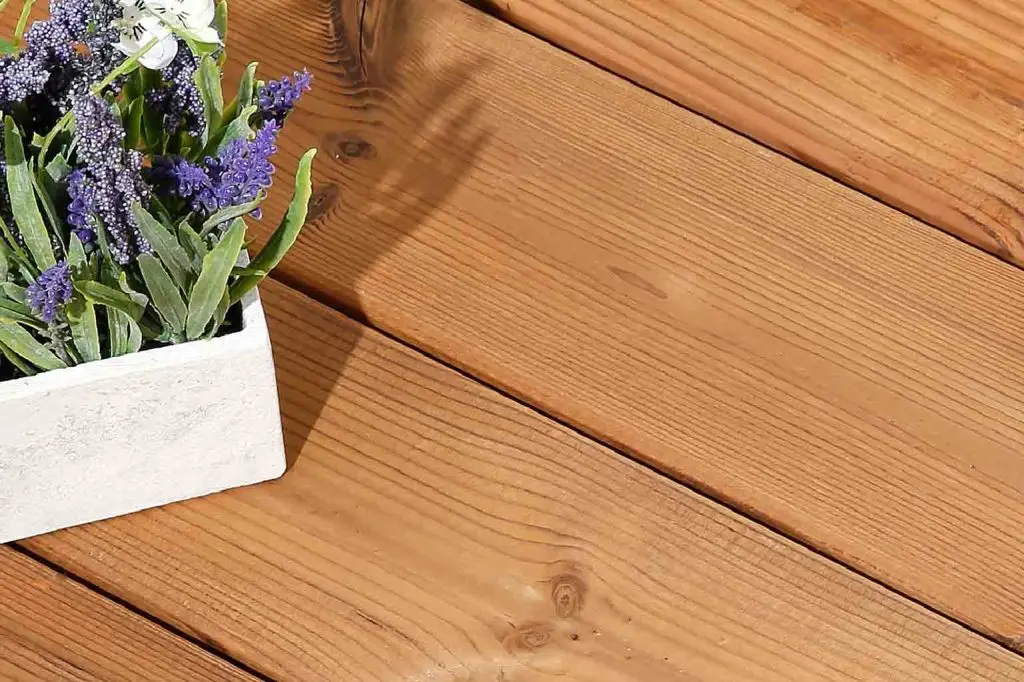
The heat treatment process gives thermowood a rich, warm brown tone throughout the full depth of the board. Over time, like all uncoated exterior timbers, thermowood will weather to a natural silver-grey if left untreated. Many architects and designers specify it specifically for this natural weathering quality.
Sustainable sourcing
Most thermowood is produced from fast-growing Nordic pine and spruce. Nordic pine and spruce are well-managed softwood species from certified forests. This makes it a significantly more sustainable choice than slow-growing tropical hardwoods.
Thermowood vs Pressure Treated Timber
Pressure treated (PT) timber uses chemical preservatives. These preservatives are typically copper-based compounds forced deep into the wood under pressure. It is effective, widely available, and relatively low cost. However, it carries some limitations thermowood avoids:
| Thermowood | Pressure Treated | |
| Treatment method | High-temperature steam | Chemical preservatives |
| Chemical-free | Yes | No |
| Durability class | 1–2 | 3–4 (depending on treatment) |
| Dimensional stability | Excellent | Moderate |
| Appearance | Rich brown, weathers to grey | Greenish tint initially |
| Best use | Cladding, decking, joinery | Structural framing, ground contact |
| End of life | Recyclable | Restricted (some landfill restrictions) |
For above-ground applications like cladding and decking, thermowood frequently outperforms pressure treated timber on stability and aesthetics. For ground-contact or structural applications, pressure treated or naturally durable hardwoods remain more appropriate.
Thermowood vs Siberian Larch
This is one of the most common comparisons we are asked about, and there’s no single right answer. Both are excellent exterior timbers with different strengths.
Siberian larch is a naturally durable softwood with a durability class of 3–4 in its outer sapwood and 2–3 in its heartwood. It’s knot-rich, characterful, and very popular for cladding here in the UK. It weathers beautifully to silver-grey and is very competitively priced.
Thermowood on the other hand, is usually pine or spruce that has been thermally modified. This makes its durability class reach 1 to 2 after treatment, making it technically more durable than untreated larch. It also offers better dimensional stability and a more uniform, consistent appearance. It tends to be priced slightly higher than larch.
In practice, larch is often the better choice for projects where character and cost-effectiveness are priorities. Thermowood suits projects where maximum stability, consistent colour, and chemical-free credentials are important, particularly contemporary architectural builds and eco-conscious projects.
Thermowood for Cladding
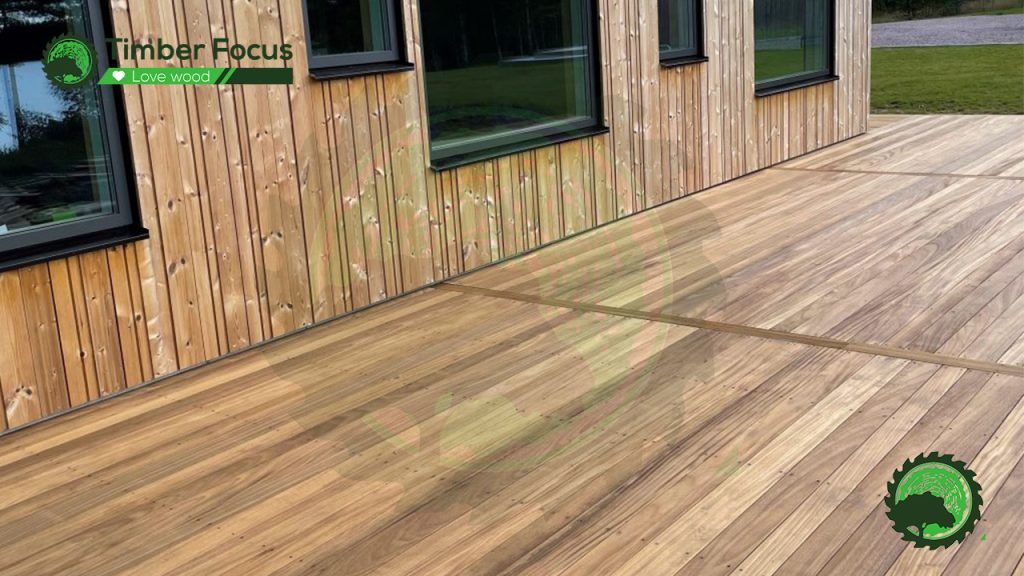
Thermowood cladding is one of the most popular uses of thermally modified timber in the UK. Its combination of stability, durability, and appearance makes it well-suited to all cladding profiles, including:
- Tongue and groove – Clean, tight joints with a smooth or shadow-gap face
- Shiplap / half-lap – Overlapping boards with good weather resistance
- Rainscreen – Open-jointed vertical or horizontal cladding on a ventilated system
- Featheredge – Traditional tapered profile, popular on rural and agricultural buildings
Because thermowood has very low moisture movement, it is particularly well-suited to tight-jointed profiles that would risk gapping or buckling with less stable timbers.
Thermowood cladding can be left to weather naturally to grey, or finished with an exterior oil or stain to maintain its warm brown tone. If you prefer a maintained appearance, a microporous oil applied every 2–3 years is sufficient.
Browse our Thermowood cladding range
Thermowood for Decking
Thermowood decking offers excellent performance for outdoor platforms, terraces, and garden rooms. Its dimensional stability means less movement between boards over seasons, which is particularly important for decking where gaps and cupping can create trip hazards and drainage issues.
Available in both smooth and grooved profiles, thermowood decking can be used with conventional face-fixing or with hidden clip systems for a clean finish. Its durability class makes it suitable for covered and uncovered decking applications in the UK climate without additional preservative treatment.
Browse our Thermowood Decking Range
What Is Thermopine?
Thermopine is simply thermowood made specifically from pine. The term is sometimes used interchangeably with thermowood, but strictly speaking thermowood is the broader category that covers thermally modified pine, spruce, ash, and other species while thermopine refers specifically to thermally modified Scots or Radiata pine.
In practice, thermopine and thermowood behave very similarly. Thermopine has a slightly lighter base colour before treatment and a warm amber-brown after modification, compared to the deeper chocolate tones sometimes seen in thermally modified spruce.
Does Thermowood Need Oiling or Treating?
Thermowood does not require chemical treatment to remain durable outdoors. However, like all exterior timbers, the choice of finish affects its appearance over time:
Left unfinished – thermowood will weather progressively to silver-grey over 12–18 months. This is a completely natural, stable finish that many customers prefer.
Oiled or stained – applying a quality exterior oil or microporous stain when first installed, and refreshing every 2–3 years, will maintain the warm brown tone and slow the weathering process.
Oiling thermowood gives no structural or durability benefit. it is purely an aesthetic choice.
Stay Updated
Get the latest timber guides, tips, and inspiration delivered to your inbox.
Newsletter
You Might Also Like
View All Posts